6 Common Mistakes in Earthwork Cut and Fill Calculation and How to Avoid Them

Accurate earthwork cut and fill calculation is paramount in any construction, landscaping, or land development project with regard to its planning, budgeting, and execution.
Whether one is shaping a golf course, preparing a commercial site, or leveling land for infrastructure, correctly estimating soil movement ensures that the final grading aligns with design intentions and environmental requirements. Despite its importance, earthwork planning has more often than not been subject to many leading errors in cost overruns, delays in construction, and long-term issues with the site.
Effective earthwork filling calculation methods, combined with technology and careful planning, contribute to eliminating such problems early in development.
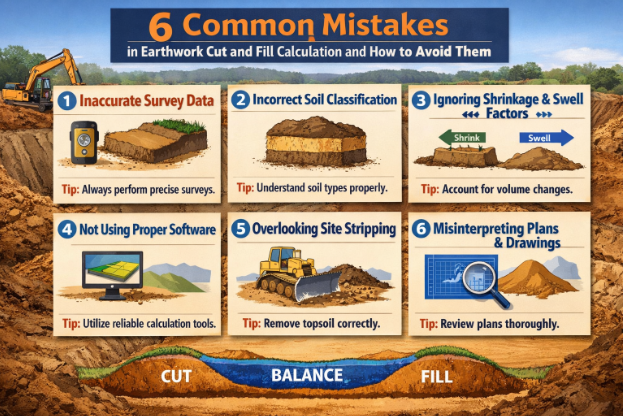
The following are six common cut and fill calculation mistakes and strategies to avoid them.
1. Inaccurate or Outdated Topographic Data
One of the biggest sources of error would be to rely on old or imprecise site surveys. Elevation data without current terrain conditions results in incorrect volume estimates, unexpected obstructions, and grading discrepancies.
How to avoid it:
- Always use fresh, high-resolution topographic surveys.
- Combine LiDAR, drone mapping, or digital modeling for greater detail.
- Validate inconsistent data before commencing any calculation process.
- Accurate, reliable data will make every earthwork cut and fill calculation far more accurate.
2. Soil Expansion and Compaction Rates
The rate of soil expansion or compaction is usually ignored.
Soil does have some quirky features in digging. Soil expands when dug and compresses when placed in fill areas. The most common reason for error in volume discrepancy is disregard for these natural happenings.
How to avoid it:
- Apply shrinkage and swell factors by soil type at standard industry rates.
- Perform in-place soil tests when feasible.
- Apply moisture adjustments to earthwork quantities.
Factoring in soil behavior in your earthwork filling calculation avoids over- and under-estimations of the material needs.
3. Not Respecting Natural Drainage Patterns
Poor grading can result in severe drainage problems, such as water pooling or erosion, or poorer turf growth in either golf or landscape projects. So many teams miscalculate the volume of cuts and fills by ignoring how water would naturally move through a site.
How to avoid it:
- Observe drainage slopes and watershed patterns before land shaping.
- Ensure fill zones have good runoff.
- Coordinate grading models with stormwater management designs.
- Land development calculation, while putting adequate consideration into drainage, ensures functionality and sustainability.
4. Inability to Accommodate Design Variations Once Construction has Begun
Design invariably changes during construction, but most teams never go back and update their earthwork calculations. Very minor changes in slope, elevation, or building footprint can greatly alter volume requirements.
How to avoid it:
- Utilize a workflow of refreshing cut and fill volumes when design revisions are made.
- Use digital modeling tools that can automatically recalculate volumes.
- Communicate regularly with designers, engineers, and contractors.
- Updates in calculation avoid cost overruns and maintain progress on the project at all times.
5. Performing Calculations Manually Instead of by Computer
The calculations are really cumbersome and prone to human error if done by hand or with obsolete methods. Advanced modeling is quite accurate for complex terrain that cannot be dealt with effectively by traditional methods.
How to avoid it:
- Use earthwork applications or 3D modelling of terrain.
- Develop multiple model scenarios to compare volume results.
- Unlock efficient processes using the power of GIS and CAD integrations.
Technology can hugely help the accuracy of each earthwork cut and fill calculation to almost eliminate the chances of major errors.
6. Poor Communication Between Design and Construction Teams
Even the most accurate calculations turn problematic when contractors misinterpret plans or grading instructions. Miscommunication leads to improper soil movement, improper grading, and costly rework.
How to avoid it:
- Distinguish everything with detailed models to ensure better clarity.
- Share plans, reports, and calculation files updated among all teams.
- Schedule regular coordination meetings to settle grading questions early.
This collaboration ensures that everyone is on the same page and knows what the planned grading strategy is.
Final Thoughts
Accurate earthwork cut and fill calculation is the very foundation of land development. Projects go much more easily and smoothly where teams can avoid the most common mistakes: using old, outdated data, ignoring soil behavior, improper drainage planning, and communication gaps.
Efficient earthwork filling calculation methods ensure accuracy in soil movement, consequently reducing environmental impacts and lowering long-term costs.
Accurate modeling tools, consistent communication, and proactive updating of calculations provide developers and construction teams with the ability to develop projects with more reliability and confidence. Complex terrain becomes a well-shaped, functional, and sustainable environment.