
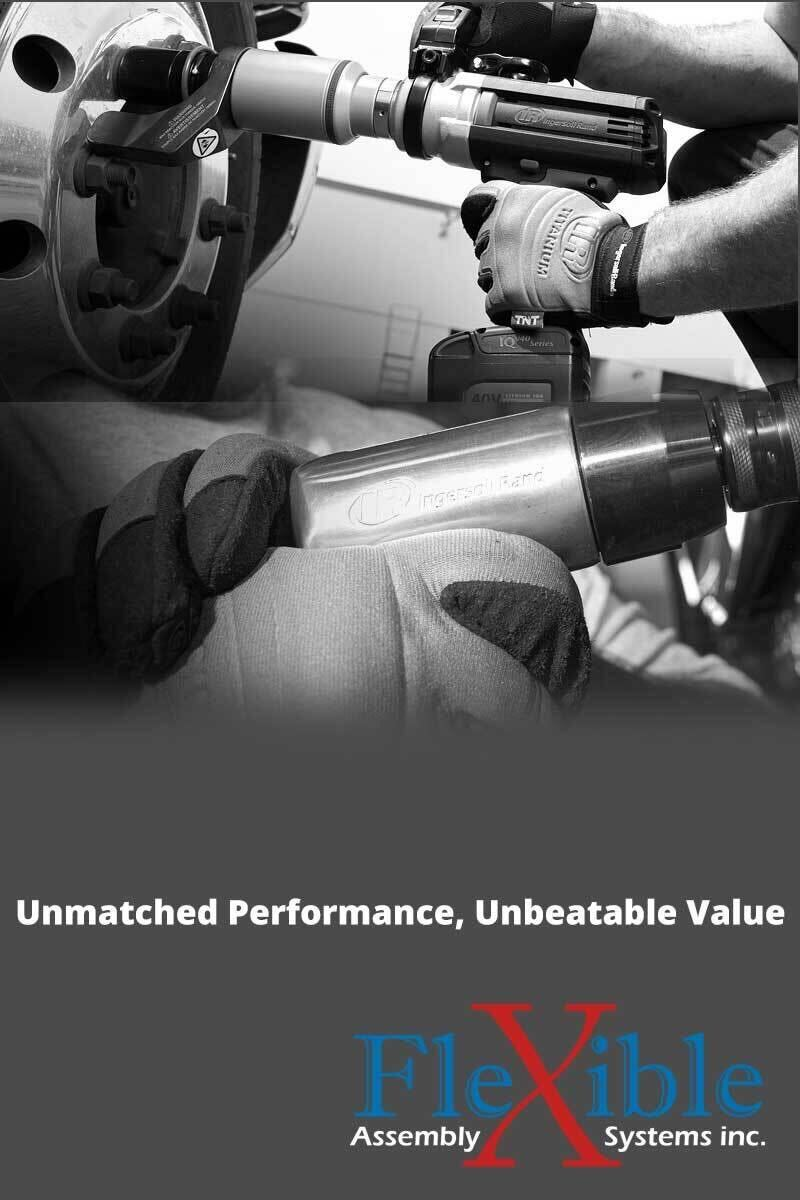
Linear Actuators and Air Motors for Flexible Automation and Reliable Torque Audits

Flexible automation cells are built to absorb product variation, mixed-model scheduling, and frequent changeovers. The challenge is that mechanical variability tends to rise at the same time: different joint stacks, shifting access angles, more reconfigurable fixturing, and more operators interacting with the process. Torque quality can drift without obvious symptoms until scrap, rework, or escapes show up downstream.
Consistent torque audits matter because fastening is a dominant special characteristic in automotive, aerospace, electronics, and industrial assembly. If torque verification is weak, the risks are predictable:
- False passesfrom worn tools, incorrect air pressure, or changing rundown rates
- False failurescaused by poor measurement technique or tester setup, leading to unnecessary adjustments
- Loss of traceabilitywhen audit results are not tied to tool ID, joint type, and calibration status
- Ergonomic shortcutswhen access is difficult, which increases operator influence and variability
Engineering and quality teams typically face a set of decisions: where pneumatic tools still make sense, how to add positioning and compliance without rebuilding the cell, and how to audit torque reliably when production is moving fast.
Linear actuators as the mechanical foundation for changeover
Linear actuators are often the simplest way to add controlled motion around a fastening task without redesigning the whole station. They contribute to automation flexibility by making the cell geometry adjustable and repeatable.
Common, high-impact uses include:
- Tool approach and retract: Consistent engagement reduces side-loading on sockets and bits, improving repeatability.
- Part clamps and nest positioning: Repeatable datum control reduces joint variability caused by part float or mislocation.
- Height and reach adjustments: Supporting mixed models by shifting fixtures or tool stands to predefined positions.
- Mechanical poka-yoke: Actuated gates, pin checks, or interlocks that enforce the correct part orientation before tightening.
Selection should be driven by the joint and access requirements, not just stroke length. Pay attention to stiffness, backlash, and duty cycle, and confirm how the actuator reacts to side loads. A compliant mount may protect tooling, but excess compliance can change the applied torque at the joint by altering seating conditions.
Air motors for adaptable fastening behavior
Air motors remain common in assembly because they handle harsh environments, tolerate stall conditions, and are easy to integrate where electrical tools are difficult to support. In flexible automation, their value is the ability to adapt quickly with relatively simple hardware changes.
Key engineering considerations:
- Torque control method: Many air tools rely on clutch mechanisms and air pressure regulation. That can be stable, but only if the supply is controlled and monitored.
- Rundown rate sensitivity: Joint type (hard vs. soft) changes how quickly torque builds. A process that passes on one joint can overshoot on another if the rundown rate shifts.
- Air quality and pressure stability: Water, oil carryover, and pressure droop change output and repeatability. Regulators, filters, and pressure sensors are part of the fastening process, not utilities.
- Reaction management: Reaction arms and fixtures must be rigid and correctly aligned; otherwise, torque is consumed in tool motion rather than the fastener.
Air motors pair well with linear actuators when access varies. Actuated approach improves alignment and reduces operator “finding the fastener” with the tool, which is a common driver of bit wear and inconsistent seating torque.
Torque testers and torque screwdrivers in production audits
Flexible cells need torque verification that is fast, repeatable, and traceable. Two common audit tools cover most needs: torque testers and torque screwdrivers. They are not interchangeable.
Torque testers
Torque testers (bench or portable) are used to verify tool output and to perform scheduled audits without depending on operator feel.
Use cases:
- Tool output verificationafter maintenance, clutch changes, or air system adjustments
- Layered process auditswhere results are logged by tool ID, joint category, and timestamp
- Trend monitoringto detect drift before it affects assemblies
Practical points:
- Accuracy and repeatabilitydepend on correct transducer range selection and proper reaction setup. Over-ranging reduces resolution; under-ranging risks overload.
- Operator influencestill exists. Misalignment, inconsistent push force, or a poor reaction fixture can change readings.
- Calibration intervalsshould match risk and usage. High-cycle production tools typically need shorter intervals than low-use audit devices.
- Traceabilityrequires documented calibration certificates, serial numbers, and controlled access to settings.
- Data capture Manual transcription increases error; digital logging supports audits and investigations.
Limitations: A tester reading is not always the same as torque delivered in the real joint. Differences in rundown rate, joint stiffness, and seating conditions can produce mismatches. Treat tester results as tool verification, and validate the process at the joint using an appropriate method when required.
Torque screwdrivers
Torque screwdrivers are a better fit for low-torque applications (common in electronics and small electromechanical assemblies) and for quick checks where portability and access matter.
Strengths:
- Fast verification on small fasteners
- Reduced risk of over-torque when properly set and used
- Useful for maintenance and setup verification on auxiliary fasteners inside fixtures
Limitations:
- Higher sensitivity to operator technique, especially with cam-out risk and inconsistent hand speed
- Not ideal for high-torque or high-cycle auditing where data capture and reaction control are needed
- Requires disciplined calibration and controlled adjustment to maintain traceability
Practical audit workflow for flexible cells
Audit steps that hold up under scrutiny
A repeatable audit routine reduces noise and prevents unnecessary tool adjustments:
- Confirm joint category(hard/soft, fastener size, seating method) and match it to the audit plan.
- Verify the air systemfor pneumatic tools: pressure at point-of-use under load, filtration status, and leak checks.
- Set up reaction and alignmentto replicate tool posture; avoid side loading the transducer.
- Run multiple samplesand record results with tool ID, operator, station, and calibration status.
- Apply rules for action: define what triggers adjustment, maintenance, or deeper investigation.
- Document changesto clutches, regulators, fixtures, or actuator positions that influence torque.
Ergonomics is not secondary. If the audit setup is awkward, operators will compensate, and repeatability will suffer. Linear actuators can help by moving fixtures or presenting the tool interface to a consistent position for both production and audit checks.
Why Choose Flexible Assembly Systems?
Flexible Assembly Systems supports projects where fastening performance, verification, and traceability must coexist with frequent changeover. That typically requires more than specifying a tool.
Support areas that matter in regulated and high-mix manufacturing include:
- Application expertiseacross pneumatic fastening, actuator-driven positioning, and reaction/fixturing design so torque results reflect the real joint conditions.
- Product range depthto match low-torque screwdriver audits, higher-torque tester setups, and the mechanical elements (reaction arms, fixtures, actuator mounts) that control variability.
- Calibration knowledgeto align calibration intervals, certificates, and traceability practices with internal quality systems and customer requirements.
- Documentation experiencefor audit records, tool control, and change management when stations are reconfigured for new variants.
Conclusion
Linear actuators and air motors can increase automation flexibility when they are treated as part of the fastening process, not just motion hardware and a power source. Actuators improve repeatable access, alignment, and fixturing, while air motors provide adaptable fastening capability in demanding environments. As flexibility rises, torque verification must become more disciplined: use torque testers for tool output and traceable audits, use torque screwdrivers where low torque and access dominate, and structure audits so results are repeatable, documented, and tied to controlled calibration practices.